The future of science and medicine will belong to students who can think critically, adapt quickly, integrate AI responsibly, and apply biological knowledge in dynamic and innovative ways. Is your child ready?
Most students learn science. Far fewer learn how to think like scientists.
The Advanced Research Mentorship Program provides the infrastructure, mentorship, and intellectual framework for motivated high school students to develop original research in the biological sciences — from identifying a question worth asking to building a hypothesis to data analysis.
Students mentored by Dr. Schmidt have gone on to compete in the Regeneron STS and ISEF competitions and publish their work in peer-reviewed journals. Yours could be next.
ENROLLMENT IS LIMITED TO ENSURE INDIVIDUALIZED MENTORSHIP AND RESEARCH SUPPORT
Mentorship that Takes Students Beyond Traditional Science Education
Students work one-on-one with Dr. Tobi Schmidt to develop research direction, evaluate scientific questions, strengthen literature analysis, explore project feasibility, and build a strategic foundation for future research projects, scientific papers, science competitions, and advanced opportunities in the biological sciences.
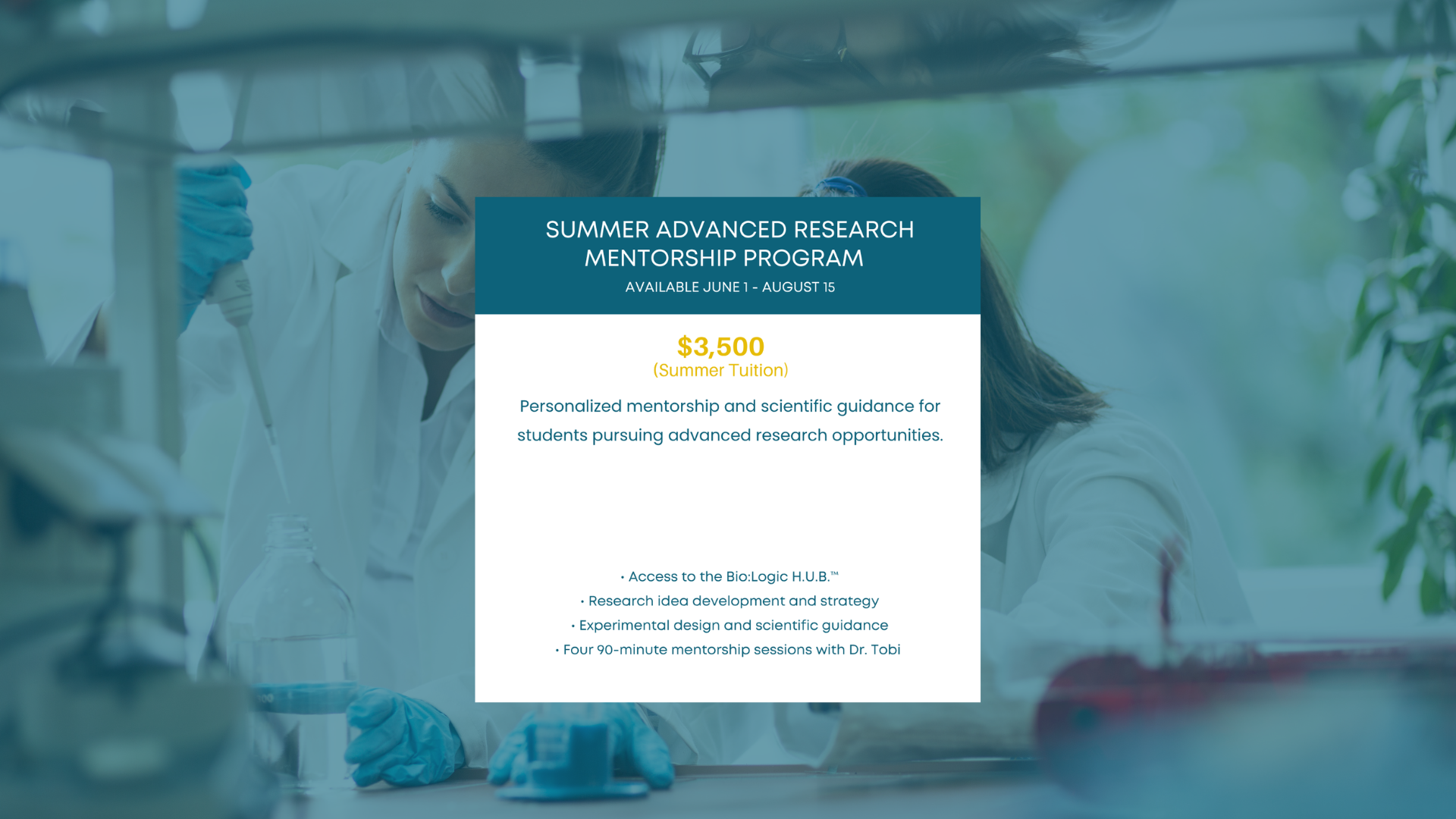
Through guided mentorship and access to the Bio:Logic Learning H.U.B.™ (Habits for Understanding Biology™), students develop scientific reasoning, experimental planning skills, data interpretation strategies, and the intellectual independence increasingly needed in modern science and medicine.
The Bio:Logic Learning H.U.B.™
The Bio:Logic Learning H.U.B.™ (Habits for Understanding Biology™) for the Advanced Research Mentorship Program is a proprietary mentorship and scientific learning framework that guides students through the process of developing research ideas, designing experiments, interpreting data, and communicating scientific work at an advanced level.
Tobi Schmidt, PhD
Dr. Tobi Schmidt is a Stanford-trained biologist and founder of Bio:Logic, a mentorship-driven learning platform for students pursuing advanced pathways in the biosciences and medicine.
With over two decades of experience in biology education, research, and scientific mentorship, Dr. Tobi has taught students ranging from foundational biology through advanced scientific inquiry. She has designed and taught biological science courses for the Stanford School of Medicine, Stanford Pre-Collegiate Studies, Stanford Continuing Studies, and the California College of the Arts.
Known for her highly personalized and intellectually dynamic mentorship style, Dr. Tobi helps students move beyond memorization to develop scientific reasoning, intellectual independence, and deeper conceptual understanding. Her work is especially effective for motivated, advanced, twice-exceptional (2e), and neurodivergent learners who often need a more adaptive and individualized approach to learning.
Through Bio:Logic, students are guided to think critically, communicate scientifically, and approach biology the way real scientists do — through reasoning, inquiry, and the ability to connect ideas across systems and disciplines.